

Lesson 1 – Course Overview & Classroom Based Assessment 1 – The Past in my Place: Lesson Overview
 Free Trial
 Sample Notes
 Share
Course Overview
Welcome to our Junior Cycle History course with your teacher Niall Lenehan.
The course covers the three strands of the Junior Cycle History specification, The Nature of History, The History of Ireland and The History of Europe and the Wider World, and prepares students for the common level exam and the Classroom-Based Assessments.

Explore the course
Five big areas of the course. Pick one to start.
The exam at a glance
Quick quiz: 10 questions
10 questions · one from every strand · get your Junior Cycle grade
Question 1 of 10
What is an artefact?
What was the Reformation?
What does ‘circumnavigation’ mean?
Which of these leaders signed the 1916 Proclamation?
What is the difference between a biography and an autobiography?
Which plantation began in 1609?
In what year did the Great Famine begin?
Who won Catholic Emancipation in 1829?
Who led Nazi Germany?
The Cold War was a rivalry between the USA and…
Free 2027 wall planner: every school holiday and exam date on one page, posted to your door.
Past exam questions by topic
All 24 questions from the 2023–2025 exams, explained in plain English. See the question, check the marking scheme, then watch the lesson.
- The historian’s toolkit: sources, archives and archaeology (3)
- Early Christian and medieval times (2)
- Exploration and the Reformation (3)
- Plantation and revolution (2)
- The Famine and emigration (2)
- Irish politics, 1900–1923 (2)
- Dictatorship, war and the Holocaust (3)
- The Cold War, the 1960s and the Troubles (3)
- Patterns of change and Irish society (4)
The historian’s toolkit: sources, archives and archaeology3 questions
-
An archivist’s work: what archives hold and how historians use them.
-
Archives and census records: the 1926 census and the 1911 census of Scattery Island.
-
Artefacts from Vindolanda, a Roman fort near Hadrian’s Wall: archaeology, dating methods and an ancient civilisation.
Early Christian and medieval times2 questions
-
The monastery at Monasterboice and art from Early Christian Ireland.
Learn it: Lesson 4: Early Christian Ireland -
A medieval round house rebuilt by UCD archaeology students: daily life and life expectancy in medieval times.
Exploration and the Reformation3 questions
-
The Reformation in Europe: causes and consequences.
Learn it: Lesson 8: The Reformation -
Exploration and colonisation in the 1400s and 1500s: ships, navigation and circumnavigation.
Learn it: Lesson 7: The Age of Exploration -
The Reformation: Tetzel and indulgences, and the religious reformer you studied.
Learn it: Lesson 8: The Reformation
Plantation and revolution2 questions
-
Sir Arthur Chichester and the Plantation of Ulster.
Learn it: Lesson 9: The Ulster Plantation -
A cartoon contrasting France and England at the time of the French Revolution.
The Famine and emigration2 questions
-
Irish emigration in the 1800s: a letter home from an emigrant in New Jersey.
Learn it: Lesson 13: The Famine in Ireland -
The Great Famine: key terms, a map of the potato blight and the consequences of the Famine.
Learn it: Lesson 13: The Famine in Ireland
Irish politics, 1900–19232 questions
-
The Home Rule Crisis, 1912–1914: Asquith, Carson and Redmond.
-
Sources on the 1916 Easter Rising: the GPO, the signatories and the consequences.
Dictatorship, war and the Holocaust3 questions
-
Stalin’s collectivisation, the Ukrainian famine and propaganda.
Learn it: Lesson 18: Life in Communist Russia -
The causes and course of World War I or World War II.
Learn it: Lesson 19: The Cause and Course of WW II -
Tomi Reichental’s I Was a Boy in Belsen: the Holocaust and groups the Nazis persecuted.
The Cold War, the 1960s and the Troubles3 questions
-
The Cold War: key terms and events.
Learn it: Lesson 21: The Cold War -
The 1960s as a decade of change.
-
Recording the deaths of the Northern Ireland Troubles.
Patterns of change and Irish society4 questions
-
Women in Irish society in the twentieth century: women TDs in Dáil Éireann.
-
A pattern of change in life and society across different time periods.
-
Technology and innovation as drivers of historical change.
-
The GAA and camogie: a cultural movement that shaped Irish life.
Exam papers and marking schemes © State Examinations Commission, opened from examinations.ie.
Download past papers
Free official exam papers and marking schemes from the State Examinations Commission.
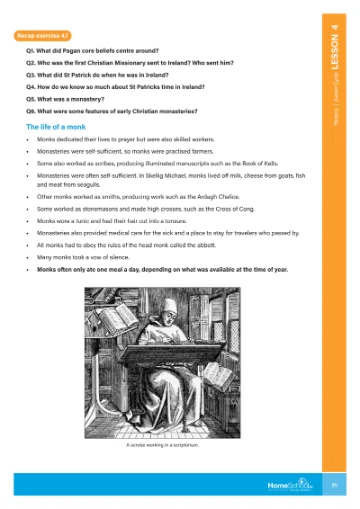
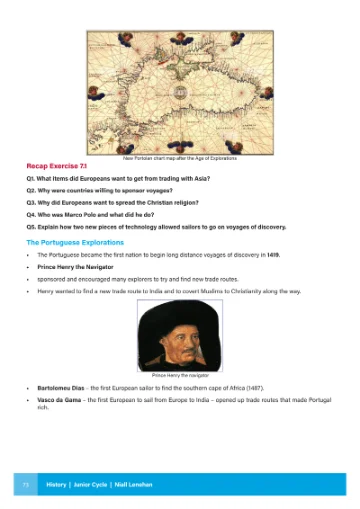
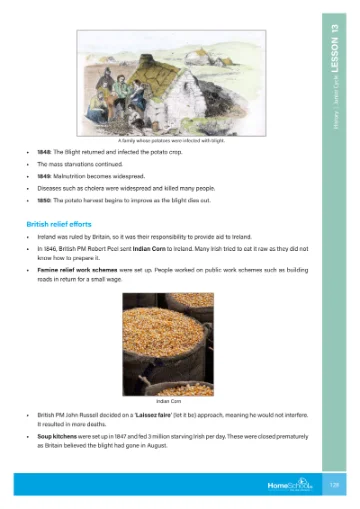
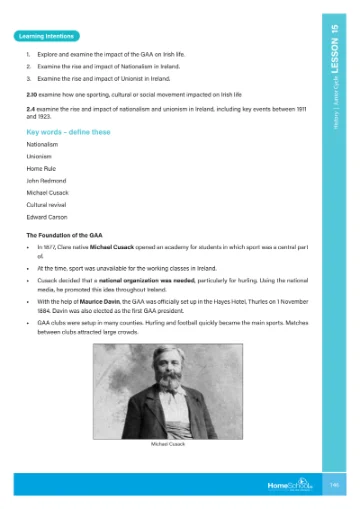
Real pages from your Junior Cycle History study manual
Your Junior Cycle History study manual
The Junior Cycle History study manual has clear notes, photos, maps and sources for every lesson, from how historians work and medieval life to the Plantations, 1916, the World Wars and the Cold War.
- Free with the course: download the notes for each lesson as you go.
- Printed copy: €40. A full-colour hard copy, posted to you.
- Free shipping when you buy any three study manuals.
Questions parents ask
Is Junior Cycle History Higher or Ordinary level?
Neither. It is common level, so everyone sits the same paper.
What is in the exam?
One 2-hour paper worth 360 marks. In recent years it has had eight questions, and you answer every question. Most use sources such as documents, photographs, maps, timelines and cartoons.
What are the CBAs?
CBA 1 is The Past in My Place, a project on the history of your local area. CBA 2 is A Life in Time, a study of a person from history. For students sitting Junior Cycle in 2026, 2027 and 2028, you complete one CBA instead of two, and the Assessment Task is not examined.
Can I try it for free?
Yes. Tap Free Trial at the top of this page to watch a lesson for free.
Free 2027 wall planner
Posted to your door. Every school holiday and exam date on one page.
Why Choose Us?
 Expert Teacher-Led Online Grinds
Mock Exam Service with Feedback from State Examiners
Affordable, High-Quality Online Grinds
Access All subjects for €55.00 per month
Start Learning TodayWe're rated as "Excellent" by our students!

Related Subjects



