

Lesson 1 How Science works: Lesson Overview
 Free Trial
 Sample Notes
 Share
Course Overview
Welcome to our Junior Cycle Science course, taught by your teacher Aileen O Sullivan.
The course covers all five strands of the Junior Cycle Science specification and the Classroom-Based Assessments, and prepares students for the final exam.

Explore the course
Five big areas. Pick one to start.
The exam at a glance
Quick quiz: 10 questions
10 questions · one from every strand · get your Junior Cycle grade
Question 1 of 10
Which of these affects the Earth’s climate mainly because of what humans do?
Which object is mostly found in a belt between Mars and Jupiter?
Which product is usually made when an acid and a base react?
A solid is heated and turns into a liquid. What is this change called?
Which particle is in the nucleus of an atom and has no charge?
Which part of a cell controls its activities?
Photosynthesis takes place in the…
What is the unit of force?
Speed equals…
In a fair test, how many variables do you change?
Free 2027 wall planner: every school holiday and exam date on one page, posted to your door.
Past exam questions by topic
All 77 questions from the 2022–2026 exams. See the question, check the answer, then watch the lesson.
- Earth and space (13)
- Measurement, motion and forces (9)
- Matter, atoms and the Periodic Table (9)
- Acids, bases and reactions (8)
- Human body systems (5)
- Ecology and habitats (5)
- Earth cycles and climate (5)
- Electricity and electronics (4)
- Genetics and evolution (4)
- Investigating in science (4)
- Energy (3)
- Materials and mixtures (3)
- Cells and living things (2)
- Human reproduction (2)
- Respiration and photosynthesis (1)
Earth and space13 questions
-
A news article about NASA's new Artemis spacesuits: their features, the dangers of space and the benefits of space exploration.
Learn it: Lesson 22: Space Exploration -
Fill in the gaps about the universe: galaxies, solar systems and comets.
-
The Moon at four positions around the Earth: phases, eclipses and the lunar cycle.
Learn it: Lesson 20: Earth, Moon & Sun -
Day, night and the seasons at three places on Earth.
Learn it: Lesson 20: Earth, Moon & Sun -
Data on Venus, Mercury, Mars and Earth: gravity, orbits, rotation and size.
-
Comets and asteroids: decide which properties belong to each.
-
A graph of the Moon's phases seen from Ireland: read the graph and name the phases.
Learn it: Lesson 20: Earth, Moon & Sun -
A NASA passage on carbon and climate change: the carbon cycle and its effects on Earth.
-
An article on solar eclipses on other planets: how eclipses happen and our solar system.
-
The Moon, a star and a planet: match each one to its description and compare their sizes.
-
Photos of the Moon: spot the New Moon and other phases of the lunar cycle.
Learn it: Lesson 20: Earth, Moon & Sun -
The Big Bang model and the evidence for it, plus the SpaceX Inspiration4 all-civilian space mission.
-
The Earth orbiting the Sun: where the Earth is over time, the seasons and the tilt of its axis.
Learn it: Lesson 20: Earth, Moon & Sun
Measurement, motion and forces9 questions
-
Stretching a spring with weights: how the extension changes with force.
Learn it: Lesson 15: Forces -
A toy car's speed over 10 seconds: drawing and reading a speed-time graph.
Learn it: Lesson 14: Motion -
The forces on a thrown football: weight, lift and air resistance.
Learn it: Lesson 15: Forces -
Fill in the gaps about mass, density, temperature, time and acceleration.
Learn it: Lesson 13: Measurements in Science -
Four distance-time and speed-time graphs: describe the motion shown in each one.
Learn it: Lesson 14: Motion -
A rollercoaster: calculate its acceleration and explain the energy and forces along the track.
Learn it: Lesson 14: MotionLesson 16: Energy -
A speed-time graph of a car journey: top speed, acceleration and describing the motion.
Learn it: Lesson 14: Motion -
How hard it is to squash white and brown bread: reading the force graph from an investigation.
-
Match measuring instruments (thermometer, voltmeter, stopwatch and more) to quantities like volume, time and temperature.
Learn it: Lesson 13: Measurements in Science
Matter, atoms and the Periodic Table9 questions
-
Magnesium: what an element is, metal and non-metal properties, and its reactions.
-
Changes of state, including sublimation: complete the diagram and decide if they are physical changes.
Learn it: Lesson 8: Materials, Matter & Density -
Bohr's model of the atom, and a reaction between element X and hydrogen.
-
A heating curve for substance X: melting point, boiling point and states of matter.
Learn it: Lesson 8: Materials, Matter & Density -
Fill in the gaps about states of matter, physical and chemical changes, and conservation of mass.
Learn it: Lesson 8: Materials, Matter & Density -
Use the Periodic Table to predict the formulas of compounds such as magnesium chloride.
-
Walton and Cockcroft's 1932 splitting of the atom, and Einstein's E = mc².
-
A diagram of an atom: particles in the nucleus, the charge on an electron, and finding the element on the Periodic Table.
-
Water: a model of the H₂O molecule and the properties of pure water.
Acids, bases and reactions8 questions
-
Breaking down hydrogen peroxide with a catalyst: measuring the oxygen and the rate of reaction.
Learn it: Lesson 11: Acids and Bases -
The pH of lemon juice, water and bleach, treating insect stings, and neutralisation.
Learn it: Lesson 11: Acids and Bases -
Energy profile diagrams for three reactions: which reaction gives out the most heat.
Learn it: Lesson 11: Acids and Bases -
Two objects with the same volume but different surface areas: volume and surface area calculations.
Learn it: Lesson 13: Measurements in Science -
Marble chips and hydrochloric acid: measuring the carbon dioxide made in a repeated investigation.
-
Label an energy profile diagram for an exothermic reaction, and name the opposite type of reaction.
Learn it: Lesson 11: Acids and Bases -
An acid and base experiment with a pH probe: name an acid and a base and read the results.
Learn it: Lesson 11: Acids and Bases -
Two acids react with a base: read the pH values and follow the neutralisation.
Learn it: Lesson 11: Acids and Bases
Human body systems5 questions
-
Label the human digestive system: mouth, oesophagus, stomach and intestines.
Learn it: Lesson 3: Organ Systems & Interactions -
Two students' heart rates before, during and after exercise: reading the graph.
Learn it: Lesson 3: Organ Systems & Interactions -
Label the human breathing system: trachea, bronchus, lung, alveolus and diaphragm.
Learn it: Lesson 3: Organ Systems & Interactions -
A bell-jar model of the breathing system: name the parts and explain how breathing works.
Learn it: Lesson 3: Organ Systems & Interactions -
The human heart and blood vessels: true or false statements and the direction of blood flow.
Learn it: Lesson 3: Organ Systems & Interactions
Ecology and habitats5 questions
-
A grassland food web: primary consumers, competition and what the arrows show.
Learn it: Lesson 5: Ecology and Habitat Study -
Ecosystems, and how global warming threatens biodiversity: reading the chart.
-
A grassland food chain: producers, consumers and how energy flows.
Learn it: Lesson 5: Ecology and Habitat Study -
A quadrat survey of a field: compare one sample with five and calculate percentage frequency.
Learn it: Lesson 5: Ecology and Habitat Study -
Habitat study equipment (pooter, net, pitfall trap), how trees compete, and protecting biodiversity.
Learn it: Lesson 5: Ecology and Habitat Study
Earth cycles and climate5 questions
-
A model of the water cycle: evaporation, condensation and the other processes.
Learn it: Lesson 21: Cycles on Earth -
Natural or human causes of climate change: ocean currents, volcanoes, cutting down trees and burning fossil fuels.
-
E-waste: reading a chart of collection rates around the world and why it matters.
-
The carbon cycle: name respiration and photosynthesis and complete the photosynthesis equation.
-
An EU article on the European Green Deal and the Farm to Fork Strategy: climate and sustainability.
Electricity and electronics4 questions
-
An LED circuit: identify the resistor and decide if statements about the circuit are true.
Learn it: Lesson 17: Electricity and Electronics -
Series and parallel circuits: what happens to the other bulbs when one bulb fails.
Learn it: Lesson 17: Electricity and Electronics -
An electric kettle: what electrical power means and calculating the energy it uses.
Learn it: Lesson 17: Electricity and Electronics -
A circuit to test current and voltage through a resistor: ammeters and reading the right graph.
Learn it: Lesson 17: Electricity and Electronics
Genetics and evolution4 questions
-
An evolution diagram showing how fish, amphibians, reptiles, birds and mammals are related.
-
Mendel's pea plants: alleles, genotypes and how height is inherited.
-
True or false statements about evolution by natural selection.
-
DNA, genes, chromosomes and the nucleus: label the diagram and answer questions on chromosome numbers.
Investigating in science4 questions
-
Match the lab equipment set-ups to the right experiments.
Learn it: Lesson 1: How Science works -
Growing cress in Moon soil and Earth soil: write a hypothesis and identify the variables.
Learn it: Lesson 1: How Science works -
A bouncing-ball investigation: graph drop-height against bounce-height and describe the pattern.
-
A distance-time graph for a trolley: calculate its average speed and compare a second run.
Learn it: Lesson 14: Motion
Energy3 questions
-
The energy-changing device you built in class: a labelled diagram, its energy conversion and efficiency.
Learn it: Lesson 16: Energy -
Renewable and non-renewable sources of electricity, and the ethics of producing energy.
Learn it: Lesson 16: Energy -
A person jumping on a trampoline: potential and kinetic energy at different points of the jump.
Learn it: Lesson 16: Energy
Materials and mixtures3 questions
-
Using an overflow can to find the volume of an iron sphere, then its density.
-
Oil, sand and water: comparing their densities in an experiment.
Learn it: Lesson 8: Materials, Matter & Density -
An investigation into the properties of sucrose (table sugar), including a melting test on a hotplate.
Learn it: Lesson 8: Materials, Matter & Density
Cells and living things2 questions
-
Using a light microscope, and fertilisation of a human egg cell.
-
Onion cells and cheek cells: find the nucleus and label the other parts of the cells.
Learn it: Lesson 2: Organisation of Living Things
Human reproduction2 questions
-
Label the human reproductive systems: ovary, uterus, Fallopian tube, testis and sperm duct.
Learn it: Lesson 6: Human Reproduction -
Label the human male and female reproductive systems.
Learn it: Lesson 6: Human Reproduction
Respiration and photosynthesis1 questions
-
Photosynthesis and respiration in a plant cell: chloroplasts, mitochondria and the gases involved.
Learn it: Lesson 7: Respiration and Photosynthesis
Exam papers and marking schemes © State Examinations Commission, opened from examinations.ie.
Download past papers
Free official exam papers and marking schemes from the State Examinations Commission.
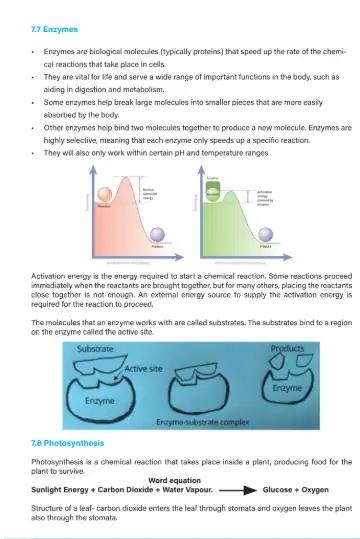
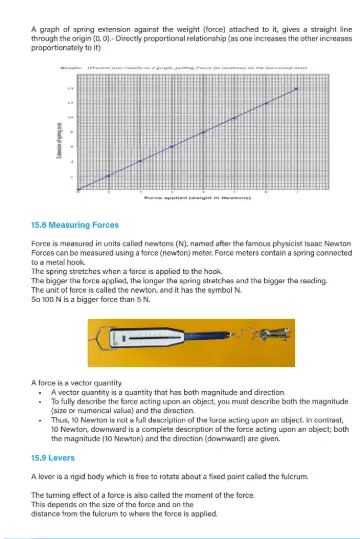
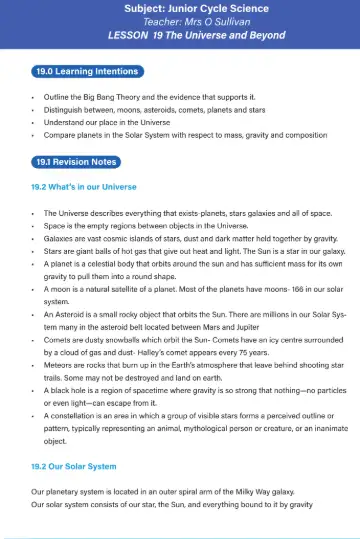
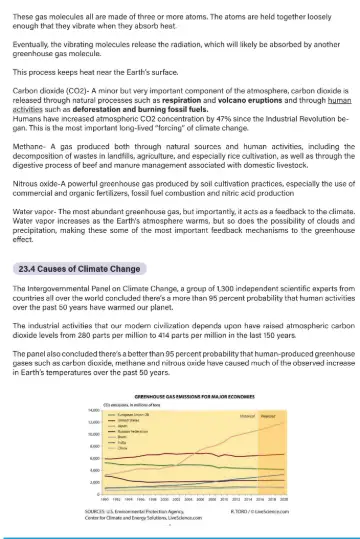
Real pages from your Junior Cycle Science study manual
Your Junior Cycle Science study manual
The Junior Cycle Science study manual has full-colour notes, diagrams and graphs for every lesson across biology, chemistry, physics and earth and space.
- Free with the course: download the notes for each lesson as you go.
- Printed copy: €40. A full-colour hard copy, posted to you.
- Free shipping when you buy any three study manuals.
Questions parents ask
Is Junior Cycle Science Higher or Ordinary level?
Neither. It is common level, so everyone sits the same paper.
How long is the exam?
2 hours, in June. It is worth 360 marks.
How many CBAs do I have to do?
For students sitting Junior Cycle in 2026, 2027 and 2028, you complete one CBA instead of two, and there is no Assessment Task.
Can I try it for free?
Yes. Tap Free Trial at the top of this page to watch a lesson for free.
Free 2027 wall planner
Posted to your door. Every school holiday and exam date on one page.
Why Choose Us?
 Expert Teacher-Led Online Grinds
Mock Exam Service with Feedback from State Examiners
Affordable, High-Quality Online Grinds
Access All subjects for €55.00 per month
Start Learning TodayWe're rated as "Excellent" by our students!

Related Subjects



